
Introductory video for the course:
General information
An online course lasting 40 hours, to be completed over 8 weeks. You will receive manuals in PDF format, step-by-step tutorials and supplementary video tutorials. It is a highly practical course, featuring a wide range of real-life case studies for students to work on. On completion of the course, a certified diploma will be issued.
Our online platform offers all the features available on the market (chat, forums, messaging, video conferencing, etc.), as well as teachers with proven professional experience.
Existe una versión Evaluación de Rhino de 90 días totalmente funcional (www.rhino3d.com/download), pero la licencia educacional tiene un coste de 195€+ IVA (www.rhino3d.com/sales).
| Duration: | 40 hours, ONLINE |
| Start date: | The 1st and 15th of each month (flexible) |
| Time: | 8 weeks |
| Price; | 200 € |
Description
Aimed at:
Naval engineers, technical naval engineers, naval architects, industrial and product designers, lecturers, students, and anyone with an interest in creating 3D designs for the naval sector.
Requirements:
A basic understanding of Rhinoceros software is recommended to follow this course. For those with no prior knowledge of Rhinoceros, we offer the Rhinoceros 3D Course: Object and Product Modelling, also run by Technical Courses.
Objectives:
The aim of the course is for students to acquire advanced knowledge and techniques in hull modelling for the shipbuilding industry through practical case studies.
At the end of the course, students will undertake a final project involving the 3D modelling of a boat, applying the knowledge gained during the course.
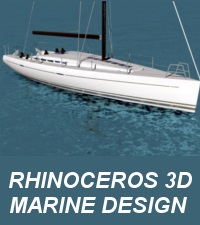
The course covers three 3D models: a sailing yacht with a fibreglass hull, a tugboat with a steel hull, and a fishing vessel with a steel hull and bulbous bow.
The course is taught by a naval architect with extensive experience in modelling the hull forms of a wide variety of vessels using various software programmes (Rhinoceros, Maxsurf, NX, etc.). Most of these are real-world projects for various shipyards that have subsequently been built. (Download the brochure for further details).
Software Description:
Rhinoceros is a widely used 3D NURBS surface modelling programme employed across many sectors. Within the shipbuilding industry, it is probably the most widely used 3D design and modelling software.
More related information::
– Modelling a helmet in 3D using Rhinoceros
Methodology:
The course is delivered online through our virtual campus in a comfortable and flexible environment by eliminating travel and the rigid schedules of face-to-face training. It also has various communication tools that allow students to stay in touch with teachers and fellow students, thus ensuring effective training with a high degree of student engagement.
The assesment of the course will be carried out by theoretical tests and practices also available online. If you pass the course with a minimum grade of five, the corresponding certificate will be issued. diploma certificado.
This course is taught by a qualified professional, who has proven professional experience and specialised training in this field.
Program
MODULE I (3D modelling techniques, interface, curves, surfaces, etc.) 1. INTRODUCTION 1.2 CAD SOFTWARE 1.3 CAM SOFTWARE 2. FUNDAMENTALS OF 3D DESIGN. THE “NURBS” CONCEPT 2.1 INTRODUCTION TO NURBS 2.2 TOPOLOGY OF NURBS 2.3 RHINOCEROS INTERFACE 2.4 EXERCISE 1-1. TOPOLOGY 2.5 EXERCISE 1-2. NURBS CUTTING 3 INTERACTION OF SURFACES. CONTINUITY AND CURVATURE 3.1 EXERCISE 1-3. DEGREE OF CURVE 3.2 CONTINUITY OF CURVES AND SURFACES 3.3 EXERCISE 1-4. CURVE CONTINUITY 3.4 EXERCISE 1-5. SURFACE CONTINUITY 3.5 EXERCISE 1-6. GENERATION OF CONTINUOUS SURFACES. BOUNDARY EDGES AND CURVE NETWORK 3.6 EXERCISE 1-7. GENERATION OF CONTINUOUS SURFACES. PATCH 3.7 EXERCISE 1-8. GENERATION OF CONTINUOUS SURFACES. TRANSITION 3.8 EXERCISE 1-9. GENERATION OF CONTINUOUS SURFACES. BLENDING 3.9 EXERCISE 1-10. GENERATION OF CONTINUOUS SURFACES. BLENDING OPTIONS 4 INTERACTION OF SURFACES. JOINTS, BLENDS AND CORNERS 4.1 EXERCISE 1-11. VARIABLE RADIUS JOINTS 4.2 EXERCISE 1-12. CHAMFER AND VARIABLE RADIUS BLEND 4.3 EXERCISE 1-13. JOINING SURFACES WITH PATCHES 4.4 EXERCISE 1-14. SMOOTH CORNERS 5 MODELLING WITH HISTORY 5.1 EXERCISE 1-15. INTRODUCTION TO HISTORY
BLOCK II (Advanced surface techniques, smoothing) 1. ADVANCED SURFACE TECHNIQUES 1.1 EXERCISE 2-1. ADAPTED SURFACES (I) 1.2 EXERCISE 2-1. ADAPTED SURFACES (II) 2. SMOOTHING CURVES TO CONTROL SURFACE QUALITY
BLOCK III (Modelling a Yacht) 1. INTRODUCTION. 2. THE SHAPE PLAN 3. MODELLING A BOAT’S HULL 3.1 EXERCISE 3-1. MODELLING THE HULL. 3.2 EXERCISE 3-2. MODELLING THE BOAT’S DETAILS.
SECTION IV (Modelling a tugboat) 1. INTRODUCTION 1.1 EXERCISE 4-1. MODELLING THE HULL. 1.2 EXERCISE 4-2. REMINDER ON PREPARING THE HULL FOR THE ADDITION OF DETAILS.
SECTION V (Modelling a fishing vessel with a bulbous bow) 1. INTRODUCTION 2. MODELLING SHAPES 2.1 EXERCISE 5-1. MODELLING THE HULL. 2.2 EXERCISE 5-2. REMINDER ON PREPARING THE HULL FOR THE ADDITION OF DETAILS. 3 BASIC CONCEPTS ON STRUCTURAL PROCESSING. 3.1 EXERCISE 5-3. SHEET METAL UNFOLDING. 3.2 EXERCISE 5-4. SHEET METAL NESTING.
Teachers

Pablo Mira-Oteiza
A graduate in Naval and Ocean Engineering from the Higher Polytechnic School of the University of A Coruña. He has significant experience in the conceptual design of ships and marine structures and in coordinating basic engineering projects. He has worked in the engineering departments of companies such as Navantia, Capgemini and Gabadi, on pioneering projects for the shipbuilding industry. He is highly skilled in ship form modelling using various software packages and has designed numerous ship hulls that have subsequently been built. In his work, he carries out naval architectural calculations as well as structural calculations using the finite element method.
Enrolment information
If you are interested in the course, we would appreciate it if you could pre-register by entering your details in the ‘Pre-registration’ tab, or contact us and we will answer any questions or queries you may have about this course.
Our contact details:
Contact number: +34604859663
• E-mail: info@technicalcourses.net