General information
Course taught by Teleformación 40h to be completed in 8 weeks.
They are delivered PDF manuals, en pdf, Video tutorials, Practical exercises, an online platform available 24 hours a day, 7 days a week, with multiple communication resources (chat, forums, messaging, Skype, etc.). The course is tutored by teachers with accredited professional experience in the design and interpretation of hydraulic and pneumatic diagrams. At the end of the course, the corresponding certificate will be issued. diploma – certificado.
| Duration: | 40 hours, ONLINE |
| Start date: | The 1st and 15th of each month (flexible) |
| Maximum time: | 8 weeks |
| Price: | 200 € |
Description
Aimed at:
Engineers, technical engineers, industrial technicians in general, industrial maintenance technicians, maintenance managers, naval industry technicians, offshore industry technicians, Merchant Navy engineering officers, naval mechanics, teachers, students, and anyone interested in learning how to interpret hydraulic and pneumatic plans and diagrams.
Objectives:
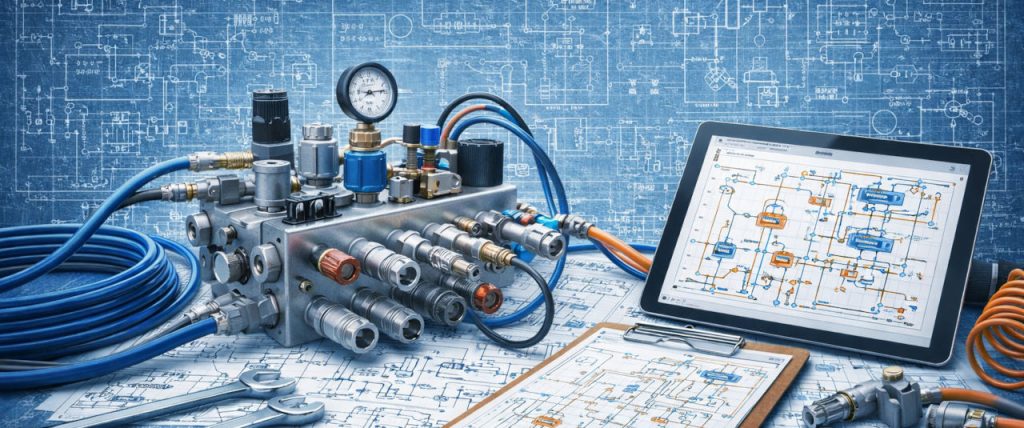
The aim of this course is to learn how to correctly interpret both hydraulic and pneumatic diagrams, recognising most of the elements and actuators used in this type of circuit and how they operate. It also includes an explanation of the different electrical actuation and control diagrams.
It is a curse eminently practical, with numerous examples of real-life cases that students will work on, ensuring their learning.
Video presentation of the course:
Methodology:
The course is delivered online through our virtual campus in a comfortable and flexible environment by eliminating travel and the rigid schedules of face-to-face training. It also has various communication tools that allow students to stay in touch with teachers and fellow students, thus ensuring effective training with a high degree of student engagement.
The assesment of the course will be carried out by theoretical tests and practices also available online. If you pass the course with a minimum grade of five, the corresponding certificate will be issued. diploma acreditativo.
This course is taught by a qualified professional, who has proven professional experience and specialised training in this field.
More related information:
HYDRAULIC SYSTEM OF THE BOW THRUSTER
Program
1.- INTRODUCTION AND HYDRAULIC AND PNEUMATIC SYMBOLS
1.1.- INTRODUCTION TO HYDRAULIC AND PNEUMATIC DIAGRAMS
1.2.- APPENDIX: HYDRAULIC SYMBOLS
1.3.- APPENDIX: PNEUMATIC SYMBOLS
2.- THEORETICAL-PRACTICAL HYDRAULICS
2.1.- HYDRAULIC INSTALLATION COMPONENTS
2.2.- INTERPRETATION OF HYDRAULIC DIAGRAMS
2.3. - SIMULATION VIDEOS OF COMPONENTS AND DIAGRAMS
2.4.- TEST
3.- HYDRAULIC PRACTICES
3.1.- PRACTICE No. 1 IDENTIFICATION-DEFINITION OF COMPONENTS
3.2.- PRACTICE No. 2 DEFINITION OF DISTRIBUTION VALVES
3. 3.- PRACTICE No. 3 DEFINITION OF HYDRAULIC CYLINDERS
3.4.- PRACTICE No. 4 DEFINITION OF PRESSURE AND CONTROL VALVES
3.5. - PRACTICE No. 5 CYLINDER MANOEUVRE DIAGRAM
3.6.- PRACTICE No. 6 CYLINDER MANOEUVRE DIAGRAM WITH RESTRICTION
3.7.- PRACTICE No. 7 HYDRAULIC CYLINDER AND MOTOR MANOEUVRE
3.8. - PRACTICE No. 8 MANOEUVRE OF ACCUMULATOR-CYLINDER BLOCK
3.9.- PRACTICE No. 9 MANOEUVRE OF VVAS. LIMITERS-ANTI-RETURNS
3.10.- PRACTICE No. 10 MANOEUVRE HYDRAULIC MOTORS
3.11.- PRACTICE No. 11 MANOEUVRE CYLINDERS-VVA. REGULATOR
3.12.- PRACTICE No. 12 MANOEUVRE PUMPS-MOTORS-CYLINDERS
4.- THEORETICAL AND PRACTICAL PART ON PNEUMATICS
4.1.- PNEUMATIC SYSTEM COMPONENTS
4.2.- SIMULATION OF PNEUMATIC COMPONENTS
4.3.- VIDEOS
4.4.- TEST
5.- PNEUMATIC PRACTICES
5.1.- PRACTICE No. 1 IDENTIFICATION-DEFINITION OF COMPONENTS
5.2.- PRACTICE No. 2 DEFINITION OF DISTRIBUTION VALVES
5. 3.- PRACTICE No. 3 DEFINITION OF PNEUMATIC CYLINDERS
5. 4.- PRACTICE No. 4 DEFINITION OF PRESSURE AND CONTROL VALVES
5.5.- PRACTICE No. 5 BASIC CYLINDER MANOEUVRE DIAGRAM
5.6.- PRACTICE No. 6 PNEUMATIC MANOEUVRE DIAGRAM
5.7.- PRACTICE No. 7 DISTRIBUTOR MANOEUVRE AND SELECTOR VALVE
5.8.- PRACTICE No. 8 PNEUMATIC MANOEUVRE
5.7.- PRACTICE No. 7 DISTRIBUTOR AND SELECTOR VVA MANOEUVRE
5.8.- PRACTICE No. 8 CYLINDER-VVA MANOEUVRE. FAST EXHAUST
5.9.- PRACTICE No. 9 MANOEUVRE OF DISTRIBUTOR VVA.S
5.10.- PRACTICE No. 10 MANOEUVRE OF CYLINDER-VVA. OF SIMULTANEITY
5.11.- PRACTICE No. 11 MANOEUVRE OF VVA. DECELERATION
5.12.- PRACTICE No. 12 PNEUMATIC TIMER MANOEUVRE
5.13.- PRACTICE No. 13 CYLINDER MANOEUVRE WITH TIMER (OPTIONAL)
5.14. - PRACTICE No. 14 PRESSURE SWITCH VALVE GROUP MANOEUVRE (OPTIONAL)
6.- ELECTRO-HYDRAULICS/ELECTRO-PNEUMATICS (OPTIONAL)
6.1.- ELECTRO-HYDRAULICS/ELECTRO-HYDRAULICS THEORY
6.2.- PRACTICAL EXERCISE No. 1 ELECTRO-HYDRAULICS
6. 3.- PRACTICAL EXERCISE No. 1 ELECTRO-PNEUMATICS
6.4.- PRACTICAL EXERCISE No. 2 ELECTRO-HYDRAULICS
6.5. - PRACTICE No. 2 ELECTRO-PNEUMATICS
6.6.- PRACTICE No. 3 ELECTRO-HYDRAULICS
6.7.- PRACTICE No. 3 ELECTRO-PNEUMATICS
Teachers
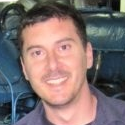
Santiago Rey García
Chief Engineer in the Merchant Navy (professional qualification), Bachelor's Degree in Naval Engineering from the University of La Coruña. He has extensive experience as an engineer and chief engineer on oil tankers, chemical tankers, ro-pax vessels and deep-sea tugs. He is certified as a FRAMO hydraulic systems operator. He has advanced knowledge of computer control systems, supervision systems and data acquisition through Scada systems. He also has years of experience in the operation and maintenance of engine rooms (both steam and diesel), predictive, preventive and corrective maintenance. He currently holds the position of Chief Engineer on deep-sea tugs.
Enrolment information
If you are interested in the course, we would appreciate it if you could pre-register by entering your details in the ‘Pre-registration’ tab, or contact us and we will answer any questions or queries you may have about this course.
Our contact details:
Contact number: +34604859663
• E-mail: info@technicalcourses.net