Cómo interpretar planos mecánicos

En cualquier proyecto de ingeniería, fabricación o desarrollo de producto, existe un lenguaje que articula todo el proceso técnico: el plano mecánico. Dominar su interpretación no es opcional para un profesional del sector industrial; es la base que permite transformar una idea en una pieza fabricable, un conjunto ensamblable y un sistema funcional.

La interpretación rigurosa de planos mecánicos permite comprender con exactitud dimensiones, tolerancias, ajustes, acabados superficiales, uniones y sistemas de representación. Sin esta competencia, el riesgo de errores en fabricación, montaje o control dimensional se multiplica. Con ella, el técnico adquiere precisión, criterio y autonomía profesional.

¿A quién va dirigido?
  • Ingenieros e ingenieros técnicos.
  • Diseñadores industriales y de producto.
  • Delineantes técnicos superiores en diseño de fabricación mecánica.
  • Técnicos del sector metal y naval.
  • Técnicos en desarrollo de producto.
  • Profesores y estudiantes de disciplinas técnicas.
  • Y cualquier profesional interesado en dominar la interpretación de planos mecánicos.

Más que leer planos: comprender ingeniería

Interpretar correctamente un plano mecánico significa entender la intención del diseño, anticipar problemas de fabricación, garantizar ajustes funcionales y asegurar la calidad del producto final.

Este curso está diseñado para quienes desean dominar el lenguaje gráfico de la ingeniería mecánica y desarrollar una competencia técnica sólida, aplicable directamente en entornos reales de fabricación, diseño y montaje industrial.
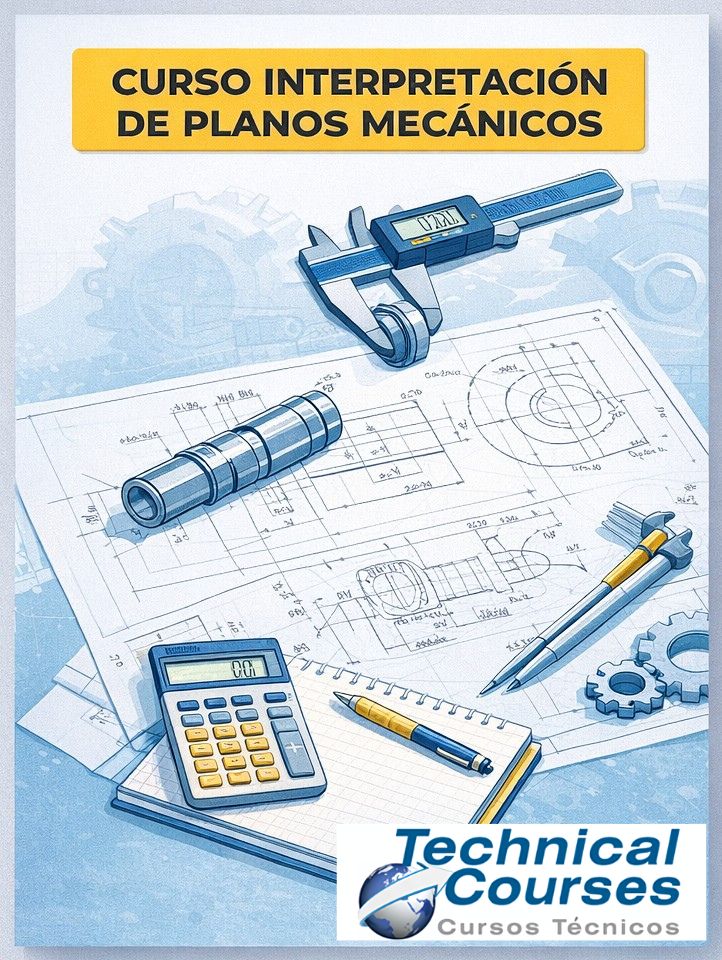
Una competencia clave en entornos de Ingeniería

Hoy más que nunca, la interpretación de planos constituye una parte esencial del conocimiento técnico. En entornos donde se desarrollan proyectos de Ingeniería, el plano es el documento contractual y técnico que define:

  • Cómo se fabrica una pieza.
  • Qué tolerancias debe cumplir.
  • Qué ajustes garantizan la intercambiabilidad.
  • Qué acabados superficiales exige el diseño.
  • Cómo se ensamblan los conjuntos.
  • Qué normativa rige su representación.

Este curso proporciona al alumno las herramientas necesarias para interpretar correctamente el sistema de representación gráfica utilizado en el diseño mecánico, entendiendo no solo “qué está dibujado”, sino qué implica técnicamente cada símbolo, cada línea y cada cota.

Methodology

La formación se imparte en modalidad online a través del campus virtual, lo que permite:

  • Flexibilidad horaria.
  • Eliminación de desplazamientos.
  • Acceso cómodo desde cualquier ubicación.
  • Comunicación directa con el profesorado y compañeros.


  • The assessment is carried out through theoretical and practical tests, also in online format. Upon passing the course with a minimum grade of five, the corresponding diploma is issued.

  • El curso está impartido por profesionales cualificados con experiencia acreditada en el ámbito industrial y formación especializada en esta materia.


Technical Courses specialises in providing training activities worldwide. Designed to meet the qualification needs of technical personnel, our courses are closely linked to trends in the world of work and the training needs of companies.
Facebook
Twitter
LinkedIn
WhatsApp
Email

Pablo Mira-Oteiza

  • Qualification
    Naval and Oceanic Engineer with a degree from the Higher Polytechnic School of the University of La Coruña.

  • Experience in the sector
    He has considerable experience in the conceptual design of ships and devices and in the coordination of basic engineering projects. He has collaborated in the engineering departments of companies such as Navantia, Capgemini and Gabadi on pioneering projects for the naval industry.

  • Areas of expertise
    He is an expert in modelling ship shapes using different software programmes and has designed numerous ship hulls that have subsequently been built. His work involves performing naval architecture calculations and structural calculations using the finite element method.

Carlos Rodriguez Vidal

  • Qualification
    Naval Technical Engineer. Degree in Naval Machinery. Master's Degree in Maritime Engineering and Doctorate from the University of A Coruña. 

  • Experience in the sector
    Spanish Merchant Navy Engineer. He has extensive experience in mechanical design and structural calculations in various engineering companies and technical offices. He has taught the professional module on the organisation of propulsion plant and auxiliary machinery maintenance on ships. He is currently a professor of Naval Engineering at the University of A Coruña. 

  • Areas of expertise
    He has participated in various R&D&I research projects at the Galicia Innovation and Services Centre and the University of La Coruña. He has published several books and technical articles for both national and international scientific journals.

María Isabel Lamas Galdo

  • Qualification
    Doctor of Industrial Engineering from the University of A Coruña. 

  • Experience in the sector

    Since 2008, she has been a lecturer at the Higher Polytechnic School of the University of A Coruña, teaching Industrial Engineering and Naval Engineering courses. She has professional experience in the field of engineering projects.

  • Areas of expertise
    She is the author of several books and numerous articles in scientific journals. She has also participated as a speaker at various national and international engineering conferences.

Miguel Cerrolaza Rivas

  • Qualification
    Doctor of Industrial Engineering from the Polytechnic University of Madrid. Master's degree in Civil Engineering from the Federal University of Rio de Janeiro (Brazil).

  • Experience in the sector
    Over 30 years of experience in finite element analysis and the use of software for numerical calculation and computer modelling. He is currently a professor at the International University of Valencia (Valencia, Spain) and the Polytechnic University of Catalonia (Barcelona, Spain).

  • Areas of expertise
    Visiting professor at the Ecole Nationale des Ponts et Chaussées (Paris) and the Colorado School of Mines (USA). Author of numerous publications in journals and nearly 10 books in the field. He has been invited to give more than 40 lectures in Europe, Asia, the USA and Latin America.

Santiago Rey García

  • Qualification
    Chief Engineer in the Merchant Navy (professional qualification), Bachelor's Degree in Marine Engineering from the University of La Coruña.

  • Experience in the sector
    He has extensive experience as an engineer and chief engineer on oil tankers, chemical tankers, ro-pax vessels and deep-sea tugs. He has several years of experience in the operation and maintenance of engine rooms (both steam and diesel), predictive, preventive and corrective maintenance. He currently holds the position of Chief Engineer on deep-sea tugs.

  • Areas of expertise
    FRAMO Hydraulic Systems Operator Certificate. Advanced knowledge of computer control systems, supervision systems, and data acquisition through SCADA systems.